


We all know journaling can reduce stress, improve emotional well-being, and provide powerful clarity. A 1998 review of expressive writing studies found that writing about emotional experiences, usually for 15-30 minutes at a time over a few days, improved people's reported physical health and psychological well-being. Journaling has also been linked to modest reductions in symptoms of depression and anxiety.
But here's the challenge most people face: staring at that blank page, unsure where to begin.
The solution isn't just writing more—it's writing with intention. Just as an artist uses different brushstrokes to create different effects, successful journalers use specific techniques to unlock different kinds of insights and breakthroughs. The power of good questions and structured prompts can transform aimless writing into a tool for genuine self-discovery.
This comprehensive guide will introduce you to 10 journaling techniques drawn from psychology and therapy, complete with 50+ guided prompts to transform your practice from aimless writing into a powerful tool for self-discovery and personal growth.
Before diving into specific methods, it's worth understanding why technique matters. Dr. James Pennebaker's groundbreaking research at the University of Texas found that people who wrote about their deepest thoughts and feelings about difficult experiences, rather than about superficial topics, went on to make fewer visits to the doctor, and some studies also found changes in immune function.
The key difference? Intention: writing to make sense of an experience.
When you apply specific journaling techniques, you're not just documenting your thoughts—you're practicing new ways of responding to your own thoughts and feelings. This is particularly powerful for managing stress and supporting mental health through intentional practice.
The Science: The phrase "stream of consciousness" comes from psychologist William James, who used it to describe the continuous flow of thought. Writing without stopping to edit gets that flow onto the page before your inner critic can step in, which is why it often turns up thoughts you didn't know you had.
Best For: Overcoming writer's block, uncovering subconscious thoughts, clearing mental clutter, and accessing creative solutions.
How to Practice:
The Science: The unsent letter borrows from expressive writing research, in which people write privately about their deepest thoughts and feelings. Knowing the letter will never be sent removes social pressure, allowing for complete emotional honesty.
Best For: Processing difficult relationships, achieving emotional closure, working through grief, and expressing feelings you can't share directly.
How to Practice:
For a complete guide to this powerful technique, explore our detailed post on writing a letter to your future self, which includes 25+ specific prompts and templates.
The Science: Looking at a situation from a new angle, which psychologists call cognitive reappraisal, is a core skill in cognitive behavioral therapy. This technique builds empathy and reduces the emotional charge around difficult situations.
Best For: Resolving conflicts, building empathy, reducing anxiety about situations, and finding creative solutions to problems.
How to Practice:
The Science: Self-determination theory research suggests that people put more sustained effort into goals that reflect their own values and interests than into goals pursued for outside approval or pressure.
Best For: Creating meaningful resolutions, making major life decisions, ensuring your actions align with your authentic self.
How to Practice:
Want to go deeper? Our comprehensive guide to values clarification through journaling provides additional exercises and prompts for discovering what truly matters to you.
The Science: In a 2005 study led by Dr. Martin Seligman, people who wrote down three things that went well each day, and why, for one week were happier and less depressed than a comparison group for up to six months afterward.
Best For: Building consistent habits, cultivating optimism, and starting or ending your day with intention.
Morning Practice:
Evening Practice:
Learn more about the transformative effects in our detailed guide: The Power of a Gratitude Journal.
The Science: Dr. Philip Zimbardo's research on time perspective describes how people differ in how much they focus on the past, present and future. Zimbardo argued that a balanced mix of the three is the healthiest.
Best For: Processing significant life events, reducing emotional reactivity, improving long-term decision-making.
How to Practice:
This technique works particularly well with self-reflection practices for deeper personal insight.
The Science: Based on cognitive behavioral therapy techniques, this method helps identify and challenge limiting thought patterns. CBT, which uses this kind of thought-questioning, is one of the best-studied talk therapies for anxiety and depression.
Best For: Managing anxiety, overcoming limiting beliefs, and building resilience.
Key Questions to Explore:
For specialized applications of this technique, explore our guides on journaling for anxiety and emotional regulation through writing.
The Science: Combines gratitude research with post-traumatic growth theory. Research on post-traumatic growth suggests that some people find new meaning and strengths after hard experiences, though not everyone does, and it can't be rushed.
Best For: Finding meaning in challenges, transforming setbacks into wisdom, connecting past lessons to future growth.
How to Practice:
The Science: Based on solution-focused therapy research, this structured approach helps move from problem identification to concrete action steps.
Best For: Solving specific challenges, making decisions, and transforming worry into productive action.
The Framework:
The Science: Research on growth mindset by Dr. Carol Dweck suggests that treating setbacks as information rather than verdicts helps people keep going, though a 2018 meta-analysis by Sisk and colleagues found its effects on academic performance are small overall. This technique offers a gentler alternative to perfectionist thinking.
Best For: Building confidence, developing a growth mindset, overcoming perfectionism, and tracking personal development.
How to Practice:
This technique pairs beautifully with habit tracking journaling for comprehensive personal development.
These prompts work beautifully with any of the techniques above. Use them for weekly reviews, birthday reflections, or whenever you want to check in with yourself.
For Emotional Processing: Use Unsent Letters, Perspective Shifting, or Temporal Perspective Integration
For Specific Mental Health Support:
For Goal Achievement: Try Values-Based Goal Setting or the Problem-Solution-Action Framework
For Daily Mindfulness: The Five-Minute Journal or Success & Learning Log work perfectly
For Creative Breakthrough: Stream of Consciousness or Dream Journaling can unlock new insights
Start Small: Choose one technique and commit to 5 minutes daily rather than attempting hour-long sessions occasionally. In our experience, consistency trumps duration for building lasting habits.
Create Rituals: Link your journaling to an existing habit. Many successful journalers write with their morning coffee or as part of their bedtime routine.
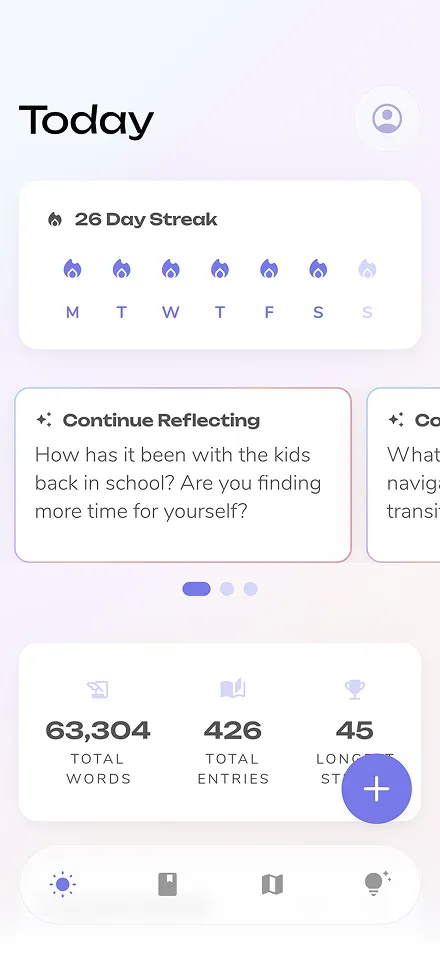
Use Technology Wisely: While pen and paper have unique benefits, digital journaling apps like Reflection can provide guided prompts, track your progress, and even offer AI-powered insights to deepen your self-awareness. Learn more about the advantages of dedicated journaling apps for consistent practice.
Track Your Progress: Notice which techniques yield the most insights and adjust your practice accordingly. Your journaling needs may evolve as you grow.
Deep self-reflection naturally surfaces challenging feelings—this is part of the healing process. If you feel overwhelmed:
For those dealing with specific challenges, we have specialized guides for trauma processing, grief work, and navigating life transitions.
Remember: growth often requires processing discomfort, but you don't have to navigate it alone.
Start with either Stream of Consciousness or the Five-Minute Journal. Stream of consciousness removes the pressure of "doing it right," while the Five-Minute Journal provides clear structure. Both build the habit without overwhelming you.
Consistency matters more than duration. Many expressive writing studies used sessions of only 15-20 minutes, and a short habit you keep beats a long one you skip. Start small and increase the time as the habit becomes natural.
Both have benefits. Handwriting can feel slower and more personal, while digital journaling offers convenience, searchability, and features like guided prompts. AI-powered journaling apps can provide personalized insights and adaptive prompts that evolve with your practice. Choose the method you'll actually use consistently.
This is where techniques and prompts become essential. Rather than facing a blank page, choose a specific technique (like Values-Based Goal Setting) or use one of the 50 prompts provided above. Structure eliminates decision paralysis. For additional inspiration, explore our daily journal prompts or specialized prompt collections for different life areas.
Look for subtle shifts: increased self-awareness, better emotional regulation, clarity in decision-making, or simply feeling more connected to yourself. The benefits often emerge gradually rather than dramatically.
While journaling is a powerful self-care tool, it complements but doesn't replace professional mental health support when needed. If you're dealing with trauma, persistent depression, or other significant mental health challenges, consider working with a qualified therapist. A 2022 review of randomized trials found that journaling gave a small benefit for mental health symptoms and recommended it as an addition to treatment, not a replacement.
Therapeutic journaling uses specific techniques designed to promote insight and emotional processing. Regular writing might focus on events, while therapeutic journaling explores thoughts, feelings, patterns, and growth opportunities using structured approaches.
Monthly or quarterly reviews can be incredibly valuable for tracking patterns and growth. Many people find that reading entries from 6-12 months ago provides surprising perspective on their journey.
While these techniques will deepen any journaling practice, modern technology can amplify their effectiveness. Reflection, an AI-powered journaling app, combines these techniques with intelligent prompts and insights that adapt to your writing patterns.
The app's extensive library of guided practices includes questions specifically designed around these techniques, helping you maintain consistency while exploring new depths of self-awareness. Whether you're processing a difficult relationship or setting meaningful goals, having the right prompt at the right time can transform a good journaling session into a breakthrough moment.
Curious about the future of journaling? Explore AI Coach, Reflection's AI-powered guide to self-discovery.
The most profound personal insights don't come from having perfect answers—they emerge from learning to ask the right questions and approaching your inner world with curiosity rather than judgment.
These 10 techniques provide you with a sophisticated toolkit for self-discovery. You don't need to master them all at once. Choose one that resonates with your current needs. Experiment. Notice what unfolds.
Your extraordinary story of growth and self-discovery begins with a single intentional word on the page. The techniques are your compass, the prompts are your starting points, and your authentic voice is the destination.
Ready to begin? Download Reflection and discover how AI-guided prompts can deepen your journaling practice and accelerate your personal growth journey.
Baikie, K. A., & Wilhelm, K. (2005). Emotional and physical health benefits of expressive writing. Advances in Psychiatric Treatment, 11(5), 338-346.
Burton, C. M., & King, L. A. (2004). The health benefits of writing about intensely positive experiences. Journal of Research in Personality, 38(2), 150-163.
Carroll, R. (2013). The bullet journal method: Track the past, order the present, design the future. Portfolio.
Dweck, C. S. (2006). Mindset: The new psychology of success. Random House.
Emmons, R. A., & McCullough, M. E. (2003). Counting blessings versus burdens: An experimental investigation of gratitude and subjective well-being in daily life. Journal of Personality and Social Psychology, 84(2), 377-389.
Hasanzadeh, P., Fallahi Khoshknab, M., & Norozi, K. (2012). Impacts of journaling on anxiety and stress in multiple sclerosis patients. Complementary Medicine Journal, 2(2), 183-193.
James, W. (1890). The principles of psychology. Harvard University Press.
Klein, K., & Boals, A. (2001). Expressive writing can increase working memory capacity. Journal of Experimental Psychology: General, 130(3), 520-533.
Lieberman, M. D., Eisenberger, N. I., Crockett, M. J., Tom, S. M., Pfeifer, J. H., & Way, B. M. (2007). Putting feelings into words: Affect labeling disrupts amygdala activity in response to affective stimuli. Psychological Science, 18(5), 421-428.
Pennebaker, J. W. (1997). Writing about emotional experiences as a therapeutic process. Psychological Science, 8(3), 162-166.
Pennebaker, J. W., & Chung, C. K. (2007). Expressive writing, emotional upheavals, and health. In Handbook of health psychology (pp. 263-284). Lawrence Erlbaum Associates.
Petrie, K. J., Fontanilla, I., Thomas, M. G., Booth, R. J., & Pennebaker, J. W. (2004). Effect of written emotional expression on immune function in patients with human immunodeficiency virus infection: A randomized trial. Psychosomatic Medicine, 66(2), 272-275.
Seligman, M. E. P., Steen, T. A., Park, N., & Peterson, C. (2005). Positive psychology progress: Empirical validation of interventions. American Psychologist, 60(5), 410-421.
Seligman, M. E. P. (2011). Flourish: A visionary new understanding of happiness and well-being. Free Press.
Smyth, J. M. (1998). Written emotional expression: Effect sizes, outcome types, and moderating variables. Journal of Consulting and Clinical Psychology, 66(1), 174-184.
Sohal, M., Singh, P., Dhillon, B. S., & Gill, H. S. (2022). Efficacy of journaling in the management of mental illness: A systematic review and meta-analysis. Family Medicine and Community Health, 10(1), e001154.
Stice, E., Burton, E., Bearman, S. K., & Rohde, P. (2007). Randomized trial of a brief depression prevention program: An elusive search for a psychosocial placebo control condition. Behaviour Research and Therapy, 45(5), 863-876.
Zimbardo, P. G., & Boyd, J. N. (1999). Putting time in perspective: A valid, reliable individual-differences metric. Journal of Personality and Social Psychology, 77(6), 1271-1288.