What is a journal that writes back?


A journal that writes back is one that responds to what you've written instead of leaving you with a blank page. In Reflection, you finish an entry and the AI Coach offers a follow-up question drawn from what you actually wrote — not the next question on a fixed list.
Most journaling stalls because you run out of things to say. A good next question keeps the thread going, and a two-line entry turns into something worth coming back to.
Still have questions?
Drop us a message, we're here to help.
hello@reflection.app
Related FAQs
Research shows that both methods provide meaningful mental health benefits. The key factor is consistency rather than medium. Digital apps offer advantages like searchability, backup, AI insights, and cross-device access, while handwriting can feel more contemplative. Choose whichever method you'll use regularly.
Apple Journal is the obvious starting point now that it runs on iPad, and it supports Apple Pencil handwriting — it is free and already there. It gives you no prompts and no structure, though, and it stops at Apple devices. For guided journaling that also syncs to Android or a browser, Reflection and Day One both run properly on iPad. For handwriting alone, GoodNotes is still the more capable notebook, but it is a note-taking app rather than a journal.
Most quality journaling apps offer export features (PDF, plain text, or JSON). Before switching, export your data from your current app. Some apps like Reflection support importing entries from other platforms, making the transition smoother.
Fewer than on iPhone, but the good ones are genuinely good. Reflection, Day One, Journey and Daylio all ship real Android apps rather than web wrappers. Apple Journal is not available on Android and will not be. If you want a free Android journal, Reflection and Daylio have the most usable free tiers.
Yes. An online diary needs no installation and works on a machine you do not control, like a work laptop. Reflection runs in the browser at web.reflection.app with the same entries as the mobile app; Penzu, Journey and Diarium also offer browser access. Check the encryption before writing anything sensitive on a shared computer.
Start with the kind, not the brand. Some journaling apps are structured, prompting you with a question each day; others hand you a blank page and stay out of the way. If you have never kept one, pick a free app that prompts you — the hardest part of journaling is knowing what to write.
Reflection offers one of the most generous free plans, including core features like AI-powered prompts and cross-device sync. Apple Journal is completely free with no paid tier at all, but it only runs on Apple devices. Day One and Daylio also offer free tiers with basic functionality. The best choice depends on your platform and whether you want AI-guided insights or simple entry logging.
A journal that writes back is one that responds to what you've written instead of leaving you with a blank page. In Reflection, you finish an entry and the AI Coach offers a follow-up question drawn from what you actually wrote — not the next question on a fixed list.
Most journaling stalls because you run out of things to say. A good next question keeps the thread going, and a two-line entry turns into something worth coming back to.
Shadow work journaling is writing deliberately about the parts of yourself you tend to avoid — the reactions, resentments and patterns that are easier not to look at.
It works best with structure, which is why Reflection includes guided journeys written by wellness experts rather than leaving you to find the right questions on your own. Our full guide to shadow work journaling walks through the practice from the start.
You can, but the two are built for different jobs. A chat window keeps no structured record of your life, gives you nowhere to come back to, and offers no promise about how what you type is handled.
Reflection is a journal first. Entries are encrypted at rest (AES-256) and in transit (TLS 1.2 or greater), and they are never used to train AI models. It's also built around time, so it can surface patterns across weeks and months rather than treating every session as a fresh start. Our business is funded by subscriptions, not by selling data.
Research on expressive writing consistently finds it helps people process difficult emotion, and many people journal alongside therapy to notice what sets a low period off and what pulls them out of it. We've gathered 16 evidence-based studies on journaling and mental health if you'd rather read the research itself.
Journaling is not a substitute for professional care. If you're struggling badly, please talk to a doctor or therapist.
If prompts are what you need, we keep sets for mental health and for depression specifically.
Often enough that it stops being a decision. For most people that means a short daily entry rather than a long weekly one — three honest sentences beat a page you dread writing.
Daily reminders help turn it into a habit, and weekly and monthly reviews give you something to look back on once the entries start to accumulate.
Reflection is made by a small team, started by two brothers — Dave and Mike Radparvar — who also run Holstee, a sister company designing tools for mindful growth.
The app grew out of something they kept seeing in the Holstee community: most people want to reflect, but find it hard to start a practice and harder still to keep one. So they set out to build a journal that didn't just record life but helped people understand it.
Reflection is available on iOS, Android, macOS and the web. You can read more about the team and what we believe on our About page.
Whatever is actually on your mind. On the days that isn't obvious, a prompt beats a blank page.
Reflection suggests personalized prompts shaped by what you've been writing about lately, and there are 100+ expert-led guided journeys if you'd rather follow a structured sequence. We also publish 365 daily journal prompts if you just want a list to work through.
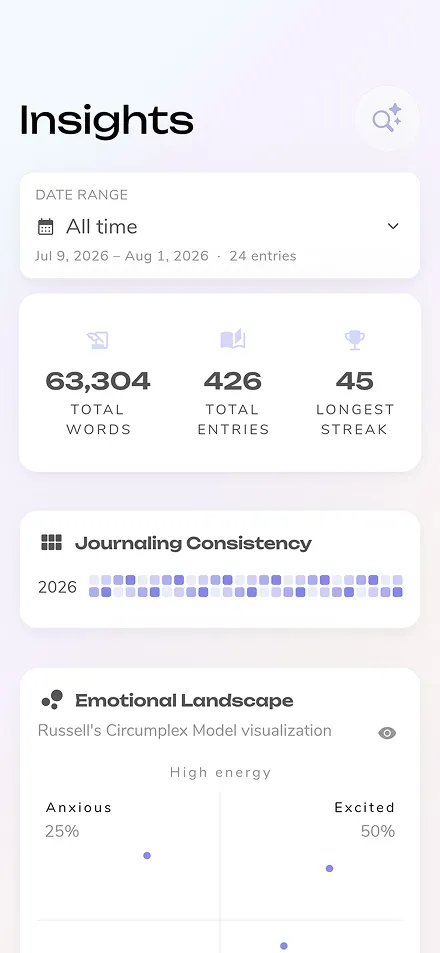
AI journaling is journaling where the app responds to what you write — offering a follow-up question, surfacing patterns across entries, or giving you somewhere to start when you don't know where to begin.
It isn't automated writing. You still do the writing; the app just makes it easier to keep going and to see what's changed over time. In Reflection this is the AI Coach, and your entries are never used to train AI models.
Many people with ADHD find journaling helps with the things that are hardest to hold in working memory — what happened, what set it off, and what actually helped. The difficulty is usually consistency rather than insight.
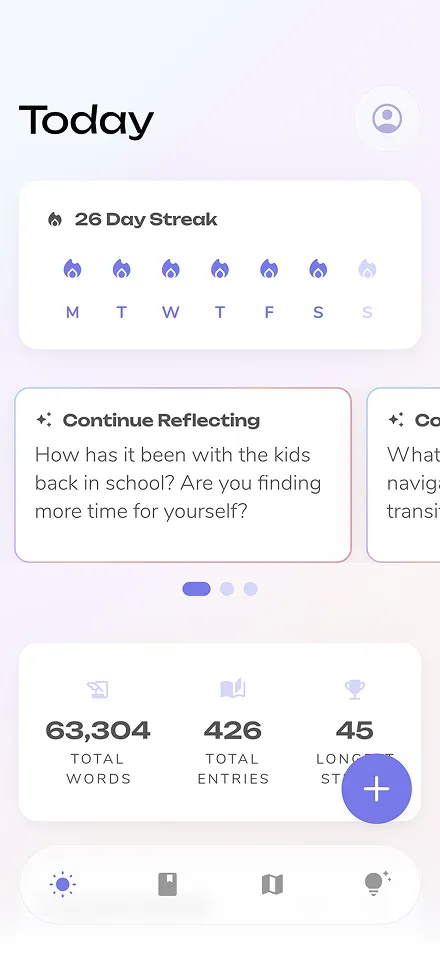
Two things in Reflection are built for exactly that: daily reminders, so the habit doesn't depend on remembering, and voice journaling, so you can talk an entry out on the days typing feels like too much. We also keep a full guide to journaling with ADHD.
Just visit web.reflection.app and log in with the same email and password you use in the mobile app. It's great for longer writing sessions where you prefer a full keyboard.
Reflection is available on iOS, Android, macOS, and the web. You can access the web app at web.reflection.app using your existing account credentials. Your entries sync seamlessly across all devices.
Reflection is an AI-powered journaling app and mental wellness coach designed to help you build a consistent self-reflection habit. Available on iOS, Android, Mac, and Web, our app combines guided prompts and AI insights to make journaling easy and impactful. Whether you need a gratitude journal, a therapy companion, or a tool for personal growth, Reflection adapts to you.
The science-backed benefits of journaling include reduced anxiety, improved mood, and greater self-awareness. Reflection is a tool for mental wellness that makes this practice easy. Our guided prompts for anxiety, self-love, and processing emotions help you navigate challenges, and many therapists recommend Reflection as a supportive tool for their clients.
Reflection's primary difference is our AI Coach. While other apps are a blank page, Reflection interacts with you, offering real-time guidance and personalized insights based on your own writing. We combine this with a library of 100+ expert-led guides and a minimal, focused design to help you go deeper, not just write more.